0
0

The ADXL355BEZ-RL7 is a digital-output, 3-axis MEMS accelerometer from Analog Devices that combines ultralow noise density, minimal zero-g offset drift, and low power consumption in a compact 6 mm × 6 mm ceramic package. Designed for precision applications that demand long-term stability with minimal calibration, this device delivers industry-leading noise performance of 22.5 µg/√Hz and a zero-g offset temperature coefficient of only ±0.15 mg/°C maximum.
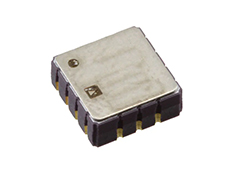
The accelerometer is housed in a 14-terminal ceramic leadless chip carrier (CLCC) package and supports selectable measurement ranges of ±2 g, ±4 g, and ±8 g. Its 20-bit ADC provides high-resolution digital output through SPI or I²C interfaces, making it suitable for inertial measurement units, platform stabilization systems, structural health monitoring, and seismic imaging applications.
The ADXL355BEZ-RL7 achieves a spectral noise density of 22.5 µg/√Hz typical on all three axes (X, Y, and Z) at 25 °C with a 3.3 V supply. This low noise floor enables detection of extremely small accelerations, making the device suitable for structural health monitoring where micro-vibration signatures indicate structural degradation, and for seismic imaging where low-level ground motion must be captured with high fidelity.
The zero-g offset drift over temperature is specified at ±0.15 mg/°C maximum, a level of stability that eliminates the need for frequent recalibration in precision applications. This characteristic is particularly valuable in industrial condition monitoring and inertial navigation systems, where offset drift directly translates into position or velocity error accumulation over time.
Three user-selectable full-scale ranges — ±2 g, ±4 g, and ±8 g — allow the device to be optimized for different sensing requirements. The ±2 g range provides the highest sensitivity at 256,000 LSB/g, suitable for tilt sensing and low-g motion detection. The ±8 g range reduces sensitivity to 64,000 LSB/g but accommodates higher acceleration events such as those encountered in robotics and transportation applications.
In measurement mode, the ADXL355BEZ-RL7 draws only 200 µA typical, making it suitable for battery-operated wireless sensor nodes and IoT devices. A sleep mode further reduces power consumption during periods when motion sensing is not required, enabling duty-cycled operation that extends battery life in remote monitoring applications.
The integrated 20-bit ADC provides high-resolution digital output directly, eliminating the need for external signal conditioning or analog-to-digital conversion. Data interpolation routines support synchronous sampling, and the device includes an integrated temperature sensor for compensation and monitoring purposes.
|
Parameter |
Specification |
|
Acceleration Range |
±2 g / ±4 g / ±8 g (selectable) |
|
Sensitivity |
256,000 / 128,000 / 64,000 LSB/g |
|
Noise Density |
22.5 µg/√Hz typ. (all axes) |
|
0g Offset vs. Temperature |
±0.15 mg/°C max. |
|
Bandwidth |
1.5 kHz |
|
ADC Resolution |
20-bit |
|
Output Interface |
SPI / I²C |
|
Supply Voltage |
2.25 V to 3.6 V |
|
Current (Measurement Mode) |
200 µA typ. |
|
Operating Temperature |
-40 °C to +125 °C |
|
Package |
14-terminal CLCC, 6 × 6 mm |
|
Self-Test |
Electromechanical self-test |
|
Temperature Sensor |
Integrated |
The device's wide operating temperature range of -40 °C to +125 °C supports use in automotive and industrial environments where temperature extremes are common. The automotive temperature grade qualification further underscores its suitability for demanding applications.
The accelerometer core consists of micromachined silicon structures that deflect under acceleration. Capacitive sensing elements detect the deflection, which is proportional to the applied acceleration. The differential capacitive architecture inherently rejects common-mode errors and provides high sensitivity to acceleration along each of the three orthogonal axes.
Analog signals from the capacitive sensing elements are conditioned and digitized by a 20-bit sigma-delta ADC. The high resolution of the converter preserves the low-noise performance of the MEMS element, ensuring that the digital output accurately represents the analog acceleration signal without introducing quantization noise that would degrade the device's measurement capability.
The ADXL355BEZ-RL7 includes digital filtering to limit noise bandwidth and a data interpolation routine for synchronous sampling. The interpolation function allows the output data rate to be synchronized with external systems, which is important in multi-sensor fusion applications where data from the accelerometer must be time-aligned with data from other sensors.
The device supports both SPI and I²C serial interfaces, providing flexibility in host processor selection. Pin names are multiplexed to serve either interface, and the device configuration is managed through internal registers accessible via the selected interface. An electromechanical self-test function allows verification of the signal chain from sensing element to digital output.
In IMU and attitude heading reference system (AHRS) designs, the ADXL355BEZ-RL7 provides the acceleration measurements required for tilt estimation and velocity integration. Its low offset drift ensures that attitude estimates do not degrade over time due to sensor bias accumulation, a critical requirement for navigation and platform stabilization systems.
The device's low noise density and high resolution enable detection of subtle structural vibrations that may indicate crack formation, bolt loosening, or material fatigue. In bridge, building, and pipeline monitoring applications, the ADXL355BEZ-RL7 captures low-level acceleration signatures that would be masked by the noise floor of conventional accelerometers-.
For seismic surveying and geophone applications, the accelerometer's 22.5 µg/√Hz noise density provides the sensitivity needed to detect weak seismic reflections. The wide dynamic range accommodates both small ground motions and larger events without saturation, while the low power consumption supports battery-operated field instruments-.
In camera gimbals, antenna pedestals, and optical stabilization platforms, the ADXL355BEZ-RL7 provides the acceleration feedback required for active stabilization. Its low latency and high resolution enable control loops that maintain pointing accuracy under vibration and dynamic motion conditions.
Robotic systems benefit from the accelerometer's combination of low noise, wide temperature range, and compact form factor. In industrial condition monitoring, the device detects anomalous vibration patterns that indicate bearing wear, imbalance, or misalignment, enabling predictive maintenance before catastrophic failure occurs.
The ADXL355BEZ-RL7's 6 mm × 6 mm CLCC package provides a robust, hermetically sealed enclosure that protects the MEMS element from environmental contaminants. The package's ceramic construction offers excellent thermal stability and matches the coefficient of thermal expansion of typical PCB materials, minimizing thermally induced stress on the solder joints.
Power supply decoupling is critical to achieving the specified noise performance. A low-noise linear regulator should be used for the 2.5 V nominal supply, with adequate bypass capacitance placed close to the device pins. The supply voltage range of 2.25 V to 3.6 V allows operation from a single lithium coin cell or from regulated 3.3 V system rails.
For applications requiring synchronous sampling, the data interpolation routine should be configured to match the host processor's timing requirements. The device's internal temperature sensor can be used for real-time compensation if the application demands the highest accuracy across the full operating temperature range.
The ADXL355BEZ-RL7 sets a high standard for precision accelerometer performance, combining ultralow noise density, exceptional offset stability, and low power consumption in a compact ceramic package. Its 20-bit digital output and selectable measurement ranges provide the flexibility needed across a diverse range of applications, from structural health monitoring to inertial navigation. For system designers where measurement fidelity and long-term stability are paramount, this accelerometer delivers the performance required for the most demanding precision sensing tasks.
WELL LINK CHIPS GROUP CO.,LIMITED FLAT/RM 1802 BEVERLY HOUSE 93-107 LOCKHART ROAD WANCHAI HK