0

OUTLINE

  • Introduction to Operational Amplifiers (Op-Amps): Why They Matter

  • What is an Operational Amplifier (Op-Amp)? Core Concepts Explained

  • Negative Feedback in Op-Amp Circuits: How It Works & Why It’s Crucial

  • How to Choose the Right Op-Amp?

  • Op-Amp Design & Troubleshooting: Best Practices

  • Conclusion

Operational Amplifier (Op-Amp) Fundamentals, Applications, & Design Guide

3 March 2026 22

Introduction to Operational Amplifiers (Op-Amps): Why They Matter

The operational amplifier is a fundamental, widely used active device in analog systems. It appears in almost all analog signal processing, including consumer electronics, industrial control, medical, automotive, and communication systems.
For electronics engineers, hardware enthusiasts, and students, understanding op-amp fundamentals is essential for analog circuit design. Mastery of its principles forms the basis for building stable, reliable circuits.
This article is a practical guide to op-amps, covering core theory, characteristics, circuit configurations, applications, device selection, design, and troubleshooting, balancing theory and engineering practicality.

What is an Operational Amplifier (Op-Amp)? Core Concepts Explained

An operational amplifier, or op-amp, is a high-gain, differential-input, single-ended output linear amplifier. Its main function is to amplify the voltage difference between its two inputs by a large factor. It is the basic building block for amplifiers, filters, comparators, oscillators, and more.
An op-amp is a multi-stage integrated amplifier with high open-loop gain.
·Typical open-loop gain for general-purpose op-amps: 100 dB ~ 140 dB
Without feedback, the output saturates. Only with feedback can it provide stable signal processing. This is the core op-amp principle.

Understanding the Op-Amp Symbol and Pinout

The standard op-amp symbol is a triangle, one of the most common symbols in electronics.

Operational Amplifiers

Two inputs:

Non-inverting input (+)
Inverting input (-)

One output: Vout

Power supply pins:

V+ (positive supply)
V- (negative supply)
In single-supply applications, where only a positive supply is used, V- (the negative supply pin) can be connected to ground (GND).
Common devices:
Dual op-amp: LM358
Quad op-amp: LM324
The output voltage cannot exceed the supply voltage rails.

Ideal Op-Amp Characteristics: Theoretical Foundation

The ideal op-amp is a benchmark for circuit analysis. It has five defining traits:
→ No current drawn from input sources.

2. Zero output impedance

→ Can drive any load.

3. Infinite open-loop gain

→ Infinitely amplifies differential voltage.

4. Infinite bandwidth

→ Amplifies all frequencies equally.

5. Zero offset voltage

→ Output is exactly 0 when input is 0.
Real op-amps cannot reach these ideals, but the model simplifies circuit analysis.


Negative Feedback in Op-Amp Circuits: How It Works & Why It’s Crucial

Negative feedback is the basis for practical op-amp circuits.
Without negative feedback, the high-gain op-amp saturates and cannot amplify linearly.
Negative feedback feeds a portion of the output signal back to the inverting input, opposing the input signal. This achieves:
· Precise gain control, independent of open-loop gain
· Improved linearity and greatly reduced distortion
· Extended bandwidth and better noise immunity
· Stabilized output against temperature and component variations
Negative feedback makes the ideal op-amp a practical device.

Basic Op-Amp Configurations: Core Circuits & Formulas

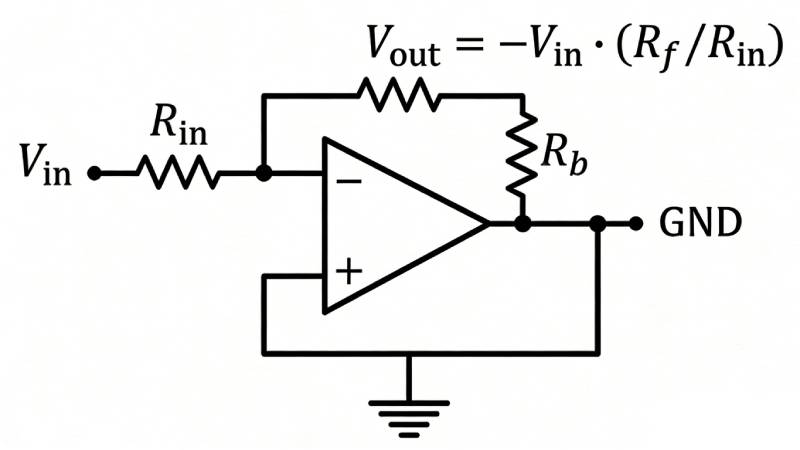
1. Inverting Operational Amplifier

The input signal goes to the inverting input.
Output is 180° out of phase with the input.

Voltage gain formula:

A_v = -frac{R_f}{R_{in}}
Key features:

· Gain can be positive or negative in sign
· Input impedance ≈ R_{in}
· Phase inversion

Typical uses: signal inversion, fixed-gain amplification, audio processing.

Illustration note:

Show circuit with:
· Signal source to R_{in} to inverting input
· R_f between output and inverting input
· Non-inverting input grounded

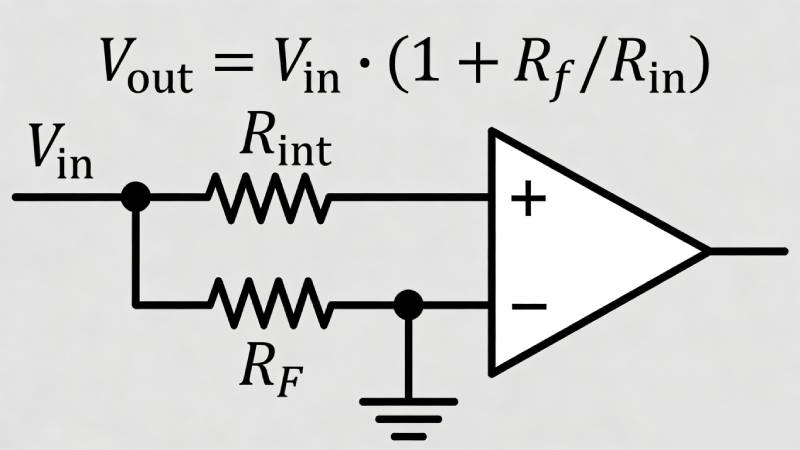
2. Non-Inverting Operational Amplifier

The input signal is applied to the non-inverting input.
Output stays in phase with input.

Voltage gain formula:

A_v = 1 + frac{R_f}{R_{in}}
Key features:

· Extremely high input impedance
· No phase inversion
· Gain ≥ 1

Typical uses: sensor preamplification, high-impedance signal acquisition.

Illustration note:

Show circuit with:
· Signal to non-inverting input
· R_{in} from inverting input to GND
· R_f from output to inverting input

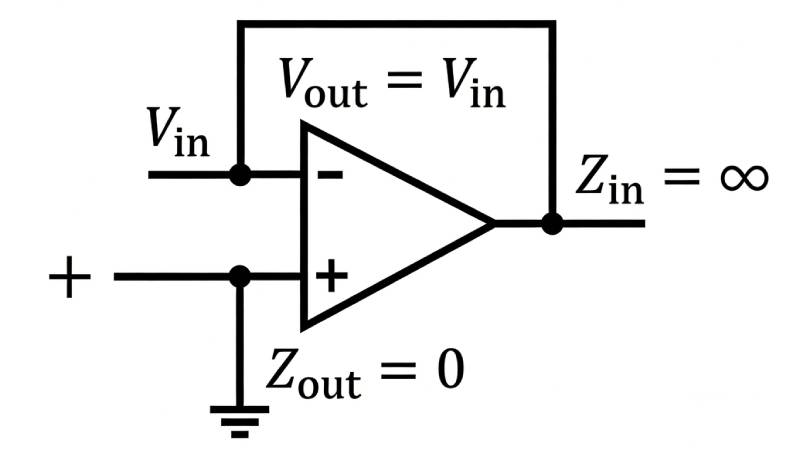
3. Voltage Follower (Buffer Amplifier)

A special case of the non-inverting amplifier with:
· R_f = 0
· R_{in} open

Voltage gain:

A_v = 1
Main purpose:

·Impedance matching
· Signal isolation
· Improve driving capability without changing amplitude

Typical uses: ADC input buffering, sensor output isolation.

Illustration note:

Show circuit with:
· Input directly to the non-inverting terminal
· Output connected directly back to the inverting terminal

4. Differential Amplifier & Summing Amplifier

Differential Amplifier

Amplifies the voltage difference and rejects common-mode signals.

Formula:

V{out} = frac{R_f}{R_{in}}(V_2 - V_1)
Foundation of instrumentation amplifiers.

Summing Amplifier

Algebraically adds multiple input voltages.
Used in signal mixing, calibration, and level-shifting circuits.

Real-World Op-Amp Behavior: Non-Ideal Characteristics

Ideal op-amps are theoretical. Real ones have non-ideal parameters that affect accuracy, stability, and frequency response.

Common Non-Ideal Parameters

· Input offset voltage: ~1–10 mV for general-purpose; μV-level for precision op-amps
· Input bias current: nA range (BJT), pA range (CMOS)
· Finite open-loop gain: ~100–140 dB, decreases at high frequencies
· -3 dB bandwidth: a few Hz to tens of Hz for general-purpose types
· Slew rate (SR): maximum output voltage change rate (V/μs)
· Finite input and output impedance

Practical Solutions to Reduce Non-Ideal Effects

· Offset voltage: use offset-null pins, external potentiometers, or precision op-amps
· Bias current: add balancing resistors to match the input resistance
· Bandwidth & slew rate: choose suitable op-amps for signal frequency
· Insufficient gain: use multi-stage amplification or high-gain devices

Op-Amp Applications: From Signal Conditioning to Advanced Systems

Signal Conditioning and Amplification

· Amplify weak sensor signals (temperature, pressure, photodiodes)
· Level shifting and impedance matching
· Filtering and noise reduction for small signals

Active Filters Using Op-Amps

Includes low-pass, high-pass, band-pass, and band-stop filters.

Advantages over passive filters:

· Provides gain
· Good impedance matching
· High precision
· Common topologies: Sallen-Key, multiple-feedback

Comparators and Oscillators

· Comparator: open-loop operation, compares voltages, used for threshold detection
· Oscillator: Wien-bridge (sine wave), relaxation (square wave)

Instrumentation Amplifiers

Built from three op-amps.
Features:
· High CMRR
· High input impedance
· Low noise
Used in precision measurement, medical monitors, and industrial scales.

Advanced Applications

·Current-to-voltage (I-V) converters
· Voltage-controlled current sources
· Voltage references
Example: photodiode conditioning.

System Design: Power, Grounding, EMI

· Use 0.1 μF decoupling capacitors near power pins
· Single-point grounding to avoid ground loops
· Shielding for high-frequency circuits to reduce EMI/RFI

How to Choose the Right Op-Amp?

Key Datasheet Parameters

· Gain-Bandwidth Product (GBW)
Closed-loop bandwidth =  dfrac{ ext{GBW}}{ ext{Gain}}
· CMRR: Common-Mode Rejection Ratio
· PSRR: Power Supply Rejection Ratio
· Input noise
· Supply voltage, power, temperature range

Op-Amp Types

· General-purpose: LM358, LM324
· Precision: OP07, AD8571
· High-speed: AD8051 (video, RF)
· Low-power: MCP6001 (battery devices)
· Voltage-feedback / current-feedback

Selection Guide

· Precision low-frequency → precision op-amp
· Battery-powered → low-power op-amp
· High-frequency → high-speed op-amp
· Learning / experiments → general-purpose
· Differential sensing → instrumentation amplifier

Op-Amp Design & Troubleshooting: Best Practices

Power Supply Design

· Dual supply for AC signals; single supply for DC signals
· Must use 0.1 μF ceramic decoupling caps
· Avoid driving large capacitive loads directly

Stability & Oscillation Prevention

Causes: low phase margin.
Solutions:
· Add compensation capacitors (lead-lag compensation)
· Series 10–100 Ω resistor at output to isolate capacitive loads
· Reduce closed-loop gain

Noise Reduction

· Short traces
· Separate analog and digital grounds
· Low-noise resistors and op-amps
· Metal shielding for high-frequency circuits

Common Troubleshooting

· Output saturated: wrong feedback, input beyond common-mode range
· Oscillation: poor decoupling, capacitive load
· Drift: offset voltage, temperature, bad grounding
· Wrong gain: incorrect resistor values or bad connections

Conclusion

Op-amp fundamentals form the foundation of analog electronics.
From ideal characteristics and negative feedback to classic configurations, non-ideal parameters, applications, selection, and design, this article provides a comprehensive overview of op-amp knowledge.
With solid theory and practical skills, you can handle nearly all analog signal processing tasks. Combining circuit debugging, datasheet analysis, and real projects will take you from theory to practice and make you a competent analog circuit designer.
Subscribe to Welllinkchips !
Your Name
* Email
Submit a request
