0
0

Whether you're wiring a smart home, fixing machines, or replacing a light, one key part stays critical: the wire connector. Often overlooked yet vital, these small parts are crucial for electrical safety and reliability.
In this thorough guide, we'll decode the world of wire connectors—from traditional twist-ons to advanced lever-actuated designs. You'll learn how to select the right connector for any application, avoid common installation pitfalls, and ensure your connections meet professional standards. Let's get connected.
Wire connectors securely join two or more electric wires. They prevent exposed wires from touching and causing short circuits, keeping electricity flowing safely.
Why proper connection counts:
Understanding the range of connector technologies is crucial to making informed choices for safe and efficient electrical work. With this foundation, let's explore the five main connector types and how each suits specific tasks.
The classic wire nut remains the most recognizable connector in North America, and for good reason. These conical-shaped devices use internal threads to twist wires together as you rotate the cap clockwise, mechanically and electrically fastening them.
As you twist the connector, the internal spring grips the wires, making a secure connection. The shell insulates against accidental contact.
Pros and cons:
|
Advantages |
Disadvantages |
|
Cost-effective (pennies per piece) |
Can loosen over time due to vibration or thermal cycling |
|
Simple, tool-free installation |
Improper sizing can damage wire strands |
|
Wide availability |
Limited reusability—re-twisting weakens the spring |
Push-in connectors use spring clamps to accept solid wires through entry ports, holding them with internal pressure.Spring clamps tightly grip inserted wires. The spring maintains pressure despite temperature changes.
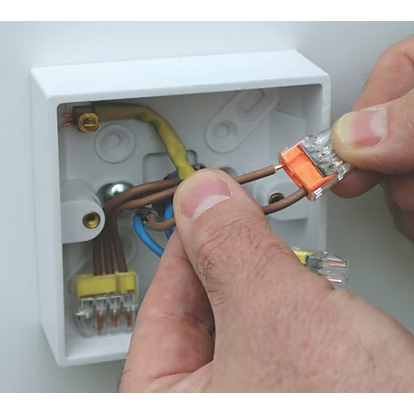 Key features:
| Advantages | Disadvantages |
| Fastest installation method | Some types limited to solid wire only |
| Consistent connection quality every time | Less reusable than lever types |
| Perfect for tight spaces | Higher unit cost than twist-ons |
Lever-nuts are versatile connectors that combine screw-terminal reliability with tool-free convenience.Lift the lever, insert the stripped wire, and snap the lever down. The clamp bites into the wire without damaging it.
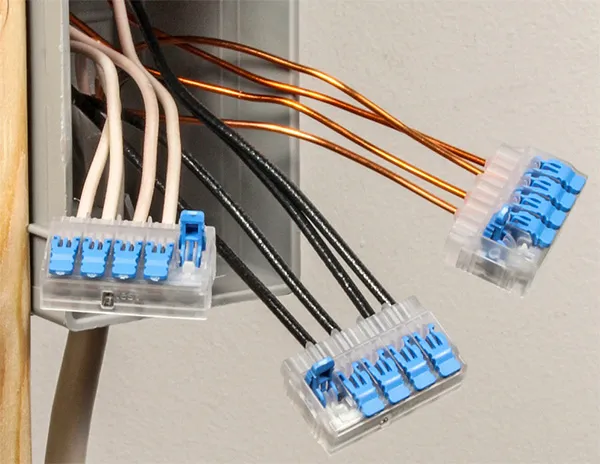 Key features:
| Advantages | Disadvantages |
| Ultimate flexibility for mixed wire types | Premium pricing (3-5x twist-on cost) |
| Ideal for temporary connections and testing | Slightly larger than push-in alternatives |
| No wire nuts to drop in tight spaces |
Crimp connectors, compressed with special tools, form strong, corrosion-resistant bonds for lasting connections.Crimping joins the connector and wire tightly, forming a strong, conductive bond.
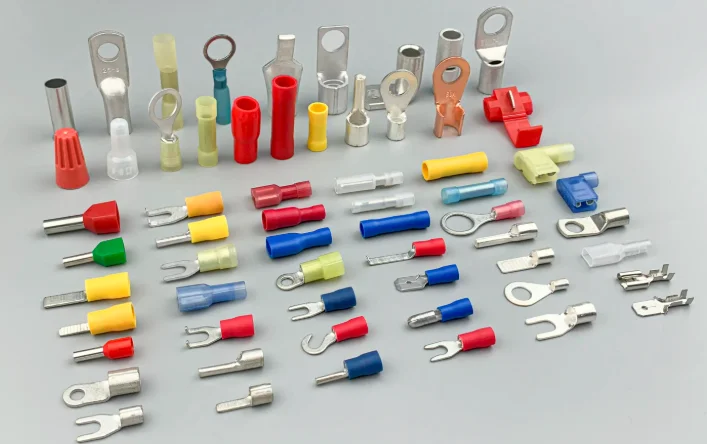 Common configurations:
| Advantages | Disadvantages |
| Vibration-proof and pull-resistant | Requires proper tooling (investment $30-$300+) |
| Smallest installed profile | Permanent—mistakes require cutting and reworking |
| Superior conductivity when done correctly | Technique-sensitive; poor crimps fail catastrophically |
Installation critical: Use the proper die size for your connector. Indent the barrel during crimping—don’t cut through. Test the crimp by pulling with a force equal to the wire’s tensile strength. Crimp the conductor and insulation sections separately, if present.
Beyond the big four, specialized applications demand purpose-built solutions:
These slice through wire insulation for contact without stripping—great for telecom and low-voltage data, but not power circuits.
Underground/Direct Burial Connectors: Gel-filled, watertight designs rated for direct earth contact (buried underground without extra protection). Essential for landscape lighting, well pumps, and outdoor subpanels.ls.
Match the connector's rated range to your conductors. Mixing solid and stranded wire? Lever-nuts handle both; twist-ons prefer matching types. Aluminum wiring requires connectors specifically listed for AL-CU compatibility.
Check that the connector ratings exceed your circuit's needs. Higher ratings are required for industrial applications.
Count your conductors and measure your box. Push-ins and lever-nuts excel in crowded 18-cubic-inch boxes; traditional wire nuts need more headroom.
If the circuit evolves (renovations, additions), lever-nuts pay for themselves in reusability. For permanent infrastructure, crimps or twist-ons suffice.
Look for UL Listed, CSA Certified, or ETL Verified marks. These indicate third-party testing regarding safety and performance. Avoid unmarked "bargain" connectors—code violations and liability exposure aren't worth the savings.
Even experienced electricians occasionally slip up. Avoid these common errors:
Never connect 14 AWG and 10 AWG in the same twist-on—the spring can't grip both properly. Use lever-nuts or step-down connectors designed for mixed gauges.
"Close enough" isn't close enough. Wires that don't reach the internal contact point create high-resistance connections that overheat. Follow strip-length specifications exactly.
Exceeding the rated wire count (typically 3-4 for standard twist-ons) prevents proper spring action and creates unreliable joints. Upgrade to larger connectors or use multiple junction points.
That standard blue wire nut in your outdoor light fixture? It's a failure waiting to happen. Always match connector ratings to environmental conditions—moisture, UV exposure, and temperature extremes degrade inappropriate materials.
Q: Can I reuse twist-on wire connectors?
A: While technically possible, we don't recommend it. The internal spring loses tension after initial installation. For applications that require frequent changes, invest in lever-nuts designed for hundreds of reuse cycles.
A: When used within specifications (proper wire gauge, correct strip length), push-ins often provide more consistent connections than hand-twisted wire nuts. The spring pressure is factory-calibrated, avoiding human variability.
A: It varies by connector size and manufacturer. Standard yellow twist-ons typically handle 3-4 #12 AWG wires; larger red models accommodate up to 6. Never exceed the package specifications—overstuffing creates fire hazards.
Q: Can I mix copper and aluminum wires in the same connector?
A: Only if the connector is specifically listed for AL-CU combinations. Dissimilar metals cause galvanic corrosion. Standard twist-ons are copper-only; aluminum connections require an antioxidant compound and compatible connectors.
A: Slight warmth under heavy load is normal, but noticeable heat indicates high resistance. Turn off the power and look for a loose connection, mismatched wire sizes, corroded conductors, or an overloaded circuit. attention.
A: For professionals and serious DIYers, absolutely. The time saved during installation and modifications, plus the ability to mix wire types, often justifies the 3-5x price premium over twist-ons. For one-time residential fixes, traditional wire nuts remain economical.
Wire connectors may be small, but their impact on electrical safety and system performance is enormous. Through understanding the strengths of twist-ons, push-ins, lever-nuts, and crimps—and selecting the right type based on your specific wire types, environmental conditions, and modification needs—you'll create connections that last for decades.
Remember: quality components installed correctly per manufacturer specifications aren't just best practice—they're code requirements that protect property and lives. Whether you're upgrading a single outlet or wiring an industrial facility, the right connector makes all the difference.
WELL LINK CHIPS GROUP CO.,LIMITED FLAT/RM 1802 BEVERLY HOUSE 93-107 LOCKHART ROAD WANCHAI HK